<html lang="en">
  <head>
    <meta charset="UTF-8" />
    <meta name="viewport" content="width=device-width, initial-scale=1.0" />
    <title>report 1402</title>

    <!-- ========== Start should change On server ========== -->
    <link
      href="https://cdn.jsdelivr.net/npm/bootstrap@5.3.0/dist/css/bootstrap.min.css"
      rel="stylesheet"
    />

    <!-- ========== End should change On server ========== -->

    <link rel="stylesheet" href="./css/report.css" />

    <script src="https://cdn.jsdelivr.net/npm/chart.js"></script>
    <link
      rel="stylesheet"
      href="https://unpkg.com/leaflet@1.9.4/dist/leaflet.css"
      integrity="sha256-p4NxAoJBhIIN+hmNHrzRCf9tD/miZyoHS5obTRR9BMY="
      crossorigin=""
    />
    <script
      src="https://unpkg.com/leaflet@1.9.4/dist/leaflet.js"
      integrity="sha256-20nQCchB9co0qIjJZRGuk2/Z9VM+kNiyxNV1lvTlZBo="
      crossorigin=""
    ></script>
  </head>
  <body>
    <section id="header">
      <div class="bg-image-container position-relative">
        <div
          class="title position-absolute top-50 start-50 translate-middle-x fs-3 fs-md-2 fs-lg-1"
        >
          <h1 style="visibility: hidden">The media was not allowed...</h1>
        </div>
      </div>

      <div class="title"></div>
    </section>
    <section class="Suppression py-5">
      <div class="container">
        <div class="row justify-content-center">
          <div class="col-md-10">
            <strong><time datetime="2024-05-03">3 May 2024</time></strong>
            <p class="mt-5">
              Midpoint School of Journalism has documented 226 cases of
              persecution against Iranian journalists in the last year,
              including instances of arbitrary summons, interrogations, arrests,
              physical assaults, expulsions and security threats.
            </p>
            <p>
              Midpoint’s findings reveal that some of the most contentious
              issues that journalists have reported on, often resulting in
              particularly harsh scrutiny and censorship from Iranian
              authorities, include discrimination against women, the enforcement
              of the hijab, economic struggles, polls on elections, and
              significant security incidents such as the Kerman explosions.
            </p>

            <p>
              The report includes cases that occurred during the Persian
              calendar year from 21 March 2023 to 21 March 2024. By March 2024,
              at least six journalists were in prison, but many more had pending
              court cases or had been banned from the profession. Significantly,
              journalists' public stories on social networks, and reports of
              organizations supporting journalists have been collected, studied,
              categorized, and analyzed. But it is believed that many cases of
              summons, threats, arrests and pressure on journalists in 2023-2024
              have not been made public, and thus are not included in this
              report.
            </p>
            <p>
              We have compiled the list of journalists and media outlets that
              were targets of repression over the past year, categorized their
              initial accusations, identified—to the extent possible—the
              institutions and authorities that have been involved, and have
              categorized the information obtained under the headings of
              location, gender, and method of repression.
            </p>
            <p>
              In this report, we have recorded cases of repression that happened
              in 2023-2024. The cases of many journalists who were summoned,
              arrested and imprisoned in previous years, and whose legal
              troubles continued in the following year, were not included in
              this report. These encounters have collectively affected the lives
              of hundreds of Iranian journalists and their families and have
              significantly infringed on the citizens' right to access
              information.
            </p>
          </div>
          <div class="col-md-12 mt-5">
            <div class="row justify-content-center">
              <div class="col-md-10 d-flex gap-4 justify-content-center">
                <div class="rectangle"></div>
                <h2 class="marked-title">
                  Forms of repression against journalists and media
                </h2>
              </div>
              <div class="col-md-10">
                <div class="">
                  <canvas id="typeBarChart"></canvas>
                  <script type="module" src="./js/report.js"></script>
                </div>
              </div>
              <div class="col-md-10 mt-5">
                <p>
                  In 2023-2024, Midpoint recorded more than 226 cases of
                  repression of journalists and media. Among these, 193 cases
                  have specifically targeted a journalist or a media manager, 54
                  of which were women and 139 of which were men, and in one case
                  the identity of the concerned person has not been disclosed.
                  In 32 other cases, a group of journalists or a media outlet
                  have been targeted, and in some cases, a censorship directive
                  has been issued collectively to all media outlets across Iran.
                </p>
                <p>
                  Also, in 2023-2024, several cases of arresting
                  citizen-journalists were reported. They have been arrested for
                  the publication of news or videos; but the status of their
                  cases is not recorded in this report.
                </p>
                <p>
                  Our monitoring shows that at least 102 journalists were tried
                  or arrested last year. 42 journalists and media managers have
                  been summoned or legal complaints have been filed against
                  them. Meanwhile, 18 journalists have been fired or forced to
                  leave their jobs.
                </p>

                <p>
                  Eight newspapers and news websites have either faced the
                  pressure of government advertisement cuts or have been
                  temporarily or permanently closed. Also, 19 cases of physical
                  attacks, beatings or even shooting with guns have been
                  recorded against journalists and media activists.
                </p>
                <p>
                  Some bodyguards of state officials have clashed with reporters
                  to prevent them from raising questions. Even during the
                  Iranian President's visit to the UN headquarters in New York,
                  acts of physical violence and snatching of a reporter's cell
                  phone were recorded - an action that could lead to prosecution
                  in the United States. In Iran, only some physical encounters
                  and attacks by bodyguards against journalists are reported in
                  the media.
                </p>
                <div class="row justify-content-between">
                  <div class="col-md-7">
                    <p>
                      Midpoint has recorded 35 cases of threats and intimidating
                      phone calls to the journalists or preventing their entry,
                      with the purpose of censoring them and obstructing the
                      flow of information. Often, the media is strictly told not
                      to disclose these calls and threats, and many of these
                      cases remain unreported.
                    </p>
                  </div>
                  <div class="col-md-5">
                    <blockquote
                      class="border border-2 p-md-0 p-3 border-md-0 bg-darkBlue-shadow bg-md-transparent"
                    >
                      Iranian authorities were primarily concerned about media
                      reporting on discrimination against women and hijab issues
                      in 2023-2024
                    </blockquote>
                  </div>
                </div>
                <p>
                  To prevent media outlets from revealing the reasons for
                  withholding vital information, they have been directed to not
                  only keep unofficial calls and threats confidential, but also
                  official directives, including those from the Supreme National
                  Security Council. Courts may summon media managers for trial
                  if they disclose these.
                </p>
                <p>
                  The results of the Midpoint monitoring show that in 2023-2024
                  the biggest concern of the Islamic Republic authorities
                  regarding the media was related to their reporting on
                  discrimination against women and hijab. The publication of
                  information about the death of Armita Gravand [a young girl
                  allegedly killed while in detention in Tehran subway for not
                  wearing hijab], the poisoning of school girls, poverty,
                  suicide, polls about the elections, the announcement of the
                  dollar price in the market, and the explosions in Kerman, has
                  been strictly controlled, and—in many cases—prohibited, except
                  in specific state-affiliated media outlets. In these cases,
                  confidential directives and decrees were sent to the media
                  managers, barring them from publishing any information on
                  these topics. This restriction was so pervasive and severe in
                  the case of the Kerman explosion terror attack, that one of
                  the editors of Iran’s state broadcaster announced that a
                  member of the Supreme National Security Council asked him via
                  a phone call not to cover the news of the explosion.
                </p>
                <p>
                  Besides arrests and summons, another method of applying
                  pressure and censorship is to cut government advertisements
                  from newspapers that are economically dependent on such
                  revenue. Through informal directives and calls, the media have
                  been told not to publish “disappointing” news and critique of
                  the state. In 2023-2024, the government advertisements of at
                  least three media outlets and newspapers were cut due to their
                  critical reportage, and two other newspapers stopped operating
                  and publishing as a result of the interruption of
                  advertisements and economic constraints.
                </p>
                <p>
                  Masih Mohajeri, the editor-in-chief of the state affiliated
                  <i>Jomhouri-e-Eslami </i> newspaper, announced last December
                  that the Ministry of Culture and Islamic Guidance has cut
                  government advertisements of this newspaper "due to their
                  critical positions." The <i>Jomhouri-e-Eslami </i> paper has
                  taken a critical look at the policies of President Raeesi’s
                  government and has repeatedly called for his resignation.
                  Editors of <i>Jomhouri-e-Eslami </i>say that they did not
                  comply with the "uncultured" requests of the Ministry of
                  Culture and Islamic Guidance, and for this reason, the
                  Ministry has stopped advertisements for the second time.
                  According to the newspaper's editor-in-chief, the officials of
                  the Ministry of Culture and Islamic Guidance of the current
                  government "do not know about the media'' and therefore "do
                  not accept any criticism and think that the media should be at
                  the disposal of their goals."
                </p>
                <p>
                  In spite of the political support it enjoys,
                  <i>Jomhouri-e-Eslami </i>, owned by Ali Khamenei, asked its
                  reporters in different provinces to attract new sources of
                  advertisement to ensure the paper's survival.
                </p>
              </div>
            </div>
          </div>
        </div>
      </div>

      <!-- <canvas id="Suppression" width="400px" height="400px"></canvas> -->
    </section>

    <!-- Repeat for more sections -->

    <section id="mapContainer">
      <div class="container">
        <div class="row justify-content-center">
          <div class="col-md-7 d-flex gap-4 justify-content-center">
            <div class="rectangle"></div>
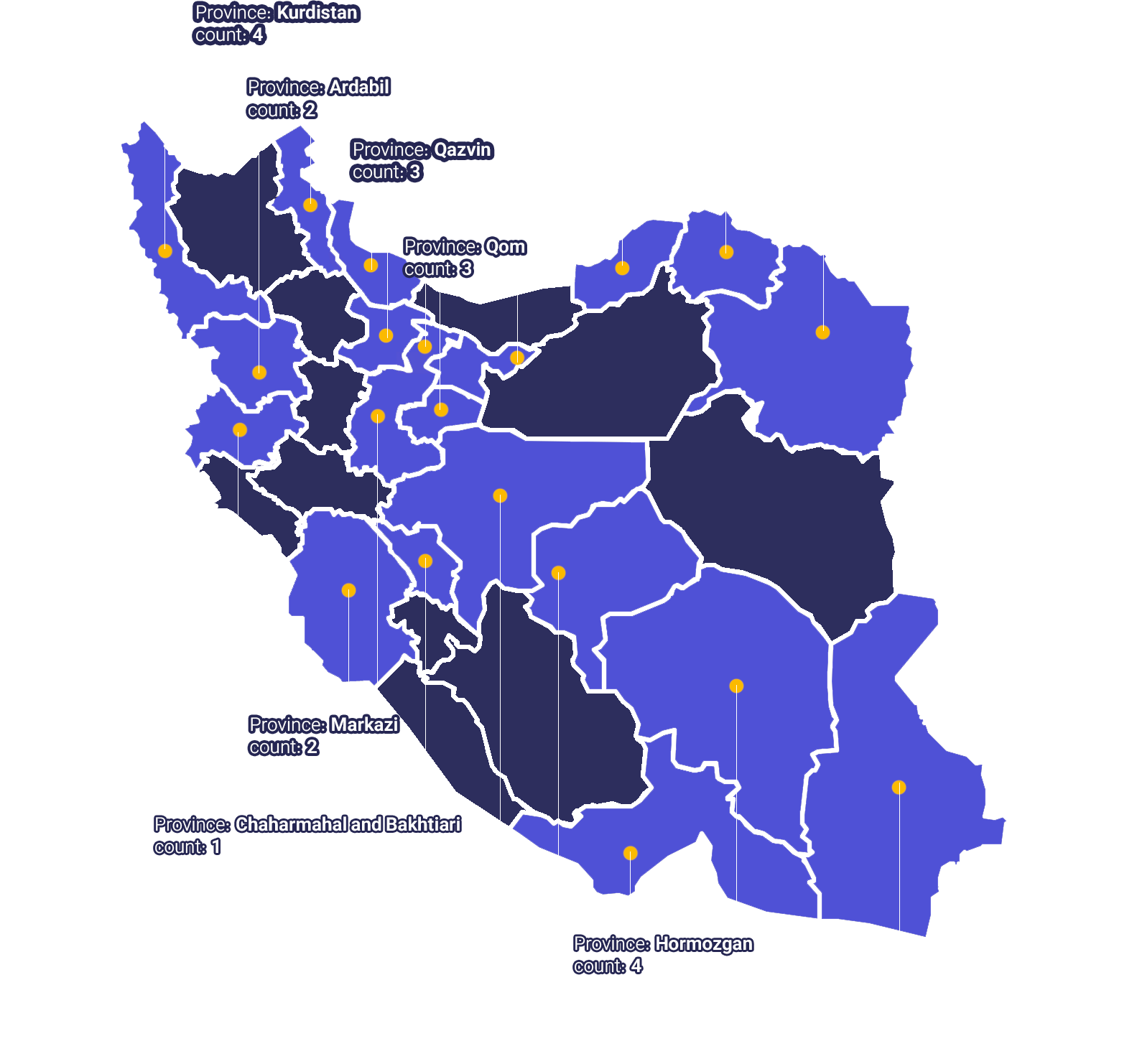
            <h2 class="marked-title">The geographical scope of repression</h2>
          </div>
          <div class="col-12 my-5 d-none d-md-block">
            <div id="map" style="background-color: #252653; height: 80vh"></div>
            <script type="module" src="./js/map.js"></script>
            <i class="d-block text-center my-3"
              >ranian provinces where cases of repression have been
              registered</i
            >
          </div>
          <div class="d-md-none col-12 mt-5">
            <img src="./images/mapMobile.png" alt="map" class="img-fluid" />
            <i class="d-block text-center my-3"
              >ranian provinces where cases of repression have been
              registered</i
            >
          </div>
          <div class="col-md-10 mt-5">
            <h3 class="mb-4">
              Added pressure on journalists outside the capital
            </h3>

            <p>
              Midpoint's findings show that most of the violent physical
              encounters, including torture, flogging, shootings and attacks on
              journalists' houses and arrests of family members, took place in
              provinces other than Tehran.
            </p>

            <div class="row justify-content-between">
              <div class="col-md-7">
                <p>
                  In Kermanshah, Vahid Shadman, a news photographer and head of
                  the<i> Qasr-e Shirin Photographers Association</i>, has
                  published pictures of his bruised and wounded body, which show
                  the effects of torture during interrogation in 2022.
                </p>
              </div>
              <div class="col-md-5">
                <blockquote
                  class="border border-2 p-md-0 p-3 border-md-0 bg-darkBlue-shadow bg-md-transparent"
                >
                  Most violent physical encounters happen against journalists
                  outside of Tehran.
                </blockquote>
              </div>
            </div>

            <p>
              In Gilan, Sajjad Rostamzadeh, the editor of <i>Masal News</i>, was
              taken to an addiction rehabilitation camp for publishing a report
              about waste recycling in the northern Gilan province of Masal,
              after his house was searched. He was eventually arrested and
              tested for addiction. The result was negative.
            </p>
            <div class="row justify-content-between">
              <div class="col-md-7">
                <p>
                  The family home of Peyman Behboodi, the manager of the
                  Telegram channel for<i>Radio Gilan</i> , who is outside of
                  Iran, was searched and his two nieces were arrested following
                  the publication of a series of reports about the alleged
                  sexual misconduct of the director of the Gilan Guidance
                  Department.
                </p>
              </div>
              <div class="col-md-5">
                <blockquote
                  class="border border-2 p-md-0 p-3 border-md-0 bg-darkBlue-shadow bg-md-transparent"
                >
                  A journalist was taken to an addiction rehabilitation camp for
                  reporting on waste recycling. Another journalist’s nieces were
                  arrested for his reporting on an official’s sexual misconduct.
                </blockquote>
              </div>
            </div>
          </div>
          <div class="col-md-10 d-flex justify-content-center">
            <div class="" style="width: 600px">
              <canvas id="citiesPieChart"></canvas>
              <script type="module" src="./js/chartsConfigs.js"></script>
              <i class="d-block text-center my-3"
                >Percentage Breakdown of Persecuted Journalists Across Iranian
                Provinces</i
              >
            </div>
          </div>
          <div class="col-md-10 mt-5">
            <p>
              In the Alborz province, independent journalist Omid Faraghat was
              banned from social media for two years by the order of a
              prosecutor while an investigation against him was ongoing, before
              a trial could even commence on the matter.
            </p>
            <p>
              In several cases, journalists across Iran have been sentenced to
              severe unusual penalties, such as "participation in professional
              ethics courses on a quarterly basis", "prohibition of socializing
              with foreign journalists" and "obligation to participate in
              behavioral and knowledge management courses".
            </p>
            <p>
              Parisa Salehi is one of the journalists who, in addition to one
              year in prison and a two-year ban on leaving the country or using
              the Internet, was also sentenced to two years of exile to the city
              of Zanjan in northwestern Iran. She was born in Zanjan but has
              been living with her family in Alborz province for many years.
              Responding to her question "why exile and why exile to Zanjan?,"
              the judge of the Karaj Revolutionary Court, wrote: "To be guided
              and reformed under the supervision of the elders of the family,"
              she said.
            </p>
          </div>
          <div class="col-md-10 mt-5">
            <h5 class="text-center my-3">
              Some other examples of repressions outside the capital:
            </h5>
            <ul>
              <li>
                In Mazandaran province in Northern Iran, a six-month prison
                sentence for a journalist and writer was changed to forced labor
                on a farm for Kelardasht prisoners.
              </li>
              <li>
                In the city of Qazvin in central Iran, the mother of a reporter
                was tried and sentenced to forced labor for protesting the
                sentence of her son. She is sentenced to do five hours of free
                work a day in a welfare center for women with mental
                disabilities.
              </li>
              <li>
                In the southern city of Bushehr, a reporter for
                <i>Darya Kenar</i>
                magazine was beaten with a shovel for criticizing a village
                council member.
              </li>
              <li>
                In Golestan province in northern Iran, a journalist was summoned
                and warned about writing a report in<i>Turkmen News</i> about a
                car accident that occurred as a result of insufficient lighting
                on his street.
              </li>
              <li>
                In Arak city in Markazi province in central Iran, a journalist
                was sentenced to prison and 74 lashes in public in the city
                mosque for attending the commemoration ceremony of one of the
                victims of the 2022 protests.
              </li>
              <li>
                In Khuzestan province, the manager of a media outlet was shot
                and died as a result.
              </li>
              <li>
                Four media activists were shot in Kohgiluyeh and Boyar Ahmad
                province in western Iran.
              </li>
            </ul>
          </div>
        </div>
      </div>
    </section>
    <section id="reasons mt-5">
      <div class="container">
        <div class="row justify-content-center mt-5 pb-5 mb-5">
          <div class="col-md-7 d-flex gap-4 justify-content-center">
            <div class="rectangle"></div>
            <h2 class="marked-title">
              Subjects covered by journalists that triggered persecution
            </h2>
          </div>
          <div class="col-md-8">
            <div>
              <canvas id="reasonsBarChart"></canvas>
              <script
                type="module"
                load="lazy"
                src="./js/reasonsChart.js"
              ></script>
            </div>
          </div>
          <div class="col-md-10 mt-5">
            <p>
              According to Midpoint’s media monitoring efforts, in 2023-2024,
              although the reasons for summoning, arresting and suppressing
              journalists are very diverse, these encounters can be categorized
              into seven sections: women and hijab, political and security,
              economic, cultural, sports, social, and undisclosed cases.
            </p>
            <p>
              However, many accusations and reasons for detention and
              interrogation remain unclear. Informed legal sources in Iran told
              Midpoint: “Lawyers know that when a prosecutor files a case
              against someone, it means that the accusation is clear and the
              person will be summoned as a defendant or at least an informed
              witness in a judicial procedure. But when a security agency
              interrogates or threatens a person, the charge is not very clear
              and the interrogator intends to deal with that person before
              filing a court case.”
            </p>
          </div>
          <div class="col-md-10 my-4">
            <!-- ========== Start hejab ========== -->
            <h3 class="mb-4">
              Repression due to coverage of women’s issues and hijab
            </h3>
            <p>
              Midpoint's findings show that in 2023-2024, the issue of hijab and
              issues related to sexual discrimination against women have
              significantly increased the sensitivity of the judicial and
              security institutions, and for this reason, many journalists have
              been summoned, detained and forced to remain silent.
            </p>
            <p>
              The editor-in-chief of <i>Shargh</i> newspaper was summoned to the
              court due to the publication of the results of a poll indicating
              that the majority of people were against the mandatory hijab and
              the "Hijab and Chastity" bill. He was also summoned to the court
              due to the publication of the Ministry of Interior's directive
              about “hijab watchers” i.e. agents that police women’s dress codes
              in the streets, on the basis that this directive was confidential.
            </p>

            <p>
              One of the journalists of <i>Shargh</i> newspaper also faced a
              lawsuit for writing and publishing a report about how the security
              forces ill-treated women in the Azadi Football Stadium.
            </p>
            <p>
              However, most instances of censorship or persecution of
              journalists when relating to comments on hijab-related issues or
              protests is with respect to their social media posts.
            </p>
            <p>
              Behrouz Behzadi, the editor-in-chief of <i>Etemad</i> newspaper,
              said in an interview that during the protests following the death
              of Mahsa Amini in the custody of Morality Police patrol, they were
              not allowed to publish articles and photos about this issue: “As
              the person responsible for the paper, I had to both protect the
              paper and offer an acceptable output to our audience.”
            </p>
            <p>
              According to Mr. Behzadi, <i>Etemad</i> was forced to publish the
              opinions of experts and analysts without publishing the original
              news. However, this newspaper has been sued for publishing
              experts' opinions "more than 40 times" in 2023-2024.
            </p>
            <!-- ========== End hejab ========== -->

            <!-- ========== Start politic ========== -->
            <h3 class="my-4">
              Repression due to political and security issues
            </h3>
            <p>
              The main reason behind the security and judicial repression of
              many journalists in 2023-2024 was their criticism of the leader of
              the Islamic Republic, the government, Parliament, the security
              forces and the way the elections were held. After the explosions
              in Kerman on January 3, 2024, journalists were not allowed to make
              critical comments, and some of them were summoned and arrested for
              this reason. One of the photographers present at the scene said
              that he was not even allowed to take pictures.
            </p>
            <p>
              Reporting on elections in March 2024 has been an issue for
              journalists and the media—journalists were not allowed to include
              any criticism in their reporting, including themes like corruption
              and low voter turnouts. In one case, the
              <i> Khabar Online</i> outlet was asked to remove from its website
              a report on the results of an official government body’s poll
              about the elections.
            </p>

            <!-- ========== End politic ========== -->
            <!-- ========== Start unknown ========== -->
            <h3 class="my-4">
              Repression due to unknown or undisclosed reasons
            </h3>
            <p>
              The reasons for many cases of arbitrary summons, complaints and
              arrests of journalists or persecution of media outlets in
              2023-2024 were not explained to them, nor did journalists have the
              opportunity and security guarantees to announce the reasons for
              these encounters. For this reason, we have categorized these as
              “unknown or undisclosed”. Many accusations against journalists and
              the media are not made public, and journalists are not allowed to
              discuss the reason for the summons after being questioned.
            </p>
            <p>
              In one case, the journalists of <i>Fardaye Eghtesad</i> were
              imprisoned and some were temporarily detained in the newsroom. The
              reason for this unprecedented move was not announced.
            </p>

            <!-- ========== End unknown ========== -->
            <!-- ========== Start finance ========== -->
            <h3 class="my-4">Repression due to economic and social issues</h3>
            <div class="row justify-content-between">
              <div class="col-md-7">
                <p>
                  A significant part of judicial or security encounters with
                  journalists and media have been due to reportage on sensitive
                  economic and social issues. Among the economic issues,
                  reporting on corruption, exposing cases of corruption and
                  criticizing Iran’s financial and monetary authorities have
                  been contentious, and among social issues, reporting on the
                  topics of authorities misconduct, poverty and environmental
                  problems has been a cause for concern for the authorities.
                </p>
              </div>
              <div class="col-md-5">
                <blockquote
                  class="border border-2 p-md-0 p-3 border-md-0 bg-darkBlue-shadow bg-md-transparent"
                  style="font-size: 23px"
                >
                  The government has sent a series of letters to the media,
                  ordering them not to tarnish the reputation of the state
                  through reporting on negative issues.
                </blockquote>
              </div>
            </div>

            <p>
              In a series of letters, the Supreme Council of Information
              Communication Technology of Iran, a government body empowered by
              President Raeesi as another censorship mechanism, ordered the
              media outlets, rather broadly, not to engage in
              <i>Siyahnamayi</i> (i.e. not to tarnish the reputation of the
              Islamic Republic by highlighting negative issues in their
              reporting), but examples of such slander have not been identified.
              In some cases, newspapers have been told not to write about
              "suicide due to poverty." Also, the media have been told that they
              are not allowed to announce the dollar price in the open market.
            </p>
            <p>
              Last March, the Criminal Court of the city of Sirjan in central
              Iran sentenced journalist Kimia Fathizadeh to a fine, six months
              in prison and a two-year ban on working as a journalist on charges
              of "publishing lies" and criticizing the "corruption of a member
              of Parliament"."Tarnishing the image of officials and the state
              and disrupting people's mental security in cyberspace" were also
              among the charges.
            </p>

            <!-- ========== End finance ========== -->
            <!-- ========== Start culture ========== -->
            <h3 class="my-4">Repression due to cultural and artistic issues</h3>
            <p>
              On cultural, artistic and sports related topics, mostly
              individuals, sports clubs and government institutions have
              complained against a newspaper or a reporter on the charge of
              "spreading lies".
            </p>
            <p>
              In Alborz province, the Department of Sports and Youth complained
              against Mustafa Faraghat for a critical tweet in which he wrote
              about the gift of a kettle and teapot by the Mohammad Shahr City
              Council to a woman who won a medal in the Asian Games.
            </p>

            <!-- ========== End culture ========== -->
          </div>
        </div>
      </div>
    </section>
    <section id="organizations">
      <div class="container">
        <div class="row justify-content-center">
          <div class="col-md-7 d-flex gap-4 justify-content-center">
            <div class="rectangle"></div>
            <h2 class="marked-title">Persecuting entities</h2>
          </div>
          <div class="col-md-10">
            <div
              class="row justify-content-center justify-content-md-around mt-5"
            >
              <div class="col-md-5">
                <div class="circlePie" style="width: 400px">
                  <canvas id="orgPieChart"></canvas>
                  <script
                    type="module"
                    load="lazy"
                    src="./js/orgChart.js"
                  ></script>
                  <div
                    id="orgPieChart-tooltip"
                    style="
                      opacity: 0;
                      position: absolute;
                      background: rgba(0, 0, 0, 0.8);
                      color: white;
                      padding: 10px;
                      border-radius: 3px;
                      pointer-events: none;
                      transition: opacity 0.2s;
                      z-index: 200;
                    "
                  ></div>
                </div>
              </div>
              <div class="col-md-6">
                <div id="chartLegend" class="chart-legend"></div>
              </div>
            </div>
          </div>
          <div class="col-md-10 my-5 py-3">
            <p>
              According to Midpoint's findings, security institutions,
              government agencies and the judiciary have been the main
              institutions pressuring and threatening the media.
            </p>
            <p>
              In many cases, it is difficult to distinguish between the security
              institutions and the judiciary, because the security institutions
              cooperate closely with the judiciary and jointly file cases to
              prosecute journalists. However, based on what has been reported,
              most cases of initial encounter and summons and complaints are
              from the security institutions respectively (81 cases), followed
              by government institutions (43 cases) and judiciary (40 cases).
            </p>
            <p>
              In more than 16 cases, it was not announced which institution was
              responsible for cautioning or prosecuting either the journalist or
              the media outlet.
            </p>
            <p>
              Following the removal of the temporary ban of
              <i>Rooydad 24</i> news website, Farhad Farzad, the editor-in-chief
              of the outlet wrote on his Twitter that an "unknown entity behind
              the curtain" blocked this website and warned them, without
              revealing his identity or accepting responsibility for this, that
              if they continue to publish "critical content" they will be banned
              permanently.
            </p>
            <p>
              In addition to judicial and security encounters, 27 cases of
              physical assault, complaints, and threats were mounted by both
              individuals and organizations against journalists, including
              bodyguards of officials, Parliamentarians, members of city and
              village councils, and semi-governmental companies.
            </p>
            <p>
              Among the list of accusations, except for undisclosed cases, a
              majority included “publishing lies”, “propaganda against the
              state”, “disturbing the public peace”, and “defamation”.
            </p>
            <p>
              In many cases, the charges against arrested or summoned
              journalists are not clear.
            </p>
          </div>
        </div>
      </div>
    </section>
    <section id="pressure">
      <div class="container">
        <div class="row justify-content-center">
          <div class="col-md-7 d-flex gap-4 justify-content-center">
            <div class="rectangle"></div>
            <h2 class="marked-title">Pressure on journalists outside Iran</h2>
          </div>
          <div class="col-md-10 text-center mt-5 pe-2">
            <img src="./images/feshar.png" alt="pressure" class="img-fluid" />
          </div>
          <div class="col-md-10 my-5">
            <div class="row justify-content-between">
              <div class="col-md-7">
                <p>
                  In this annual report, only cases of pressure on journalists
                  inside Iran were recorded. However, the pressure on
                  journalists working for Persian media outlets outside of Iran
                  has also continued. According to the documents published by
                  the <i> Edalat-e Ali</i> hacker group, there are dozens of
                  lawsuits filed against journalists of media outlets outside of
                  Iran, which prohibit them from pursuing any business or
                  economic transactions back home, eventually causing financial
                  and legal strains on their families in Iran.
                </p>
              </div>
              <div class="col-md-5">
                <blockquote
                  class="border border-2 p-md-0 p-3 border-md-0 bg-darkBlue-shadow bg-md-transparent"
                  style="font-size: 23px"
                >
                  Family members of Iranian journalists outside of Iran continue
                  to be arrested in Iran, including Iran Wire editor’s brother
                  and the niece of a DW reporter.
                </blockquote>
              </div>
            </div>
            <p>
              Also, the pressure on family members of these journalists and
              their arrests, which has been a trend in recent years, has
              continued. For instance, the brother of the editor of
              <i>Iran Wire</i> has been arrested and his father has been
              summoned. In another case, the niece of a
              <i> Deutsche Welle</i> media reporter was arrested in Lorestan
              province, and during her arrest, the agents called the reporter in
              Germany and threatened her.
            </p>
            <p>
              In 2023, the Islamic Republic of Iran was accused of planning to
              assassinate at least two journalists outside of Iran. The American
              and British governments issued statements in this regard and
              imposed sanctions against Iranian officials.
            </p>
          </div>
        </div>
      </div>
    </section>
    <section id="banner">
      <img class="w-100" src="./images/slider-eng.jpg" alt="banner" />
    </section>
    <section id="conclusion">
      <div class="container">
        <div class="row justify-content-center mt-5">
          <div class="col-md-7 my-4 d-flex gap-4 justify-content-center">
            <div class="rectangle"></div>
            <h2 class="marked-title">Conclusions</h2>
          </div>
          <div class="col-md-10 my-5">
            <p>
              Midpoint's findings show that the control and limitation of
              information through threats and subpoenas are conveyed to
              journalists even before the publication of articles. At least six
              journalists were in prison by the end of March 2024, but many more
              have pending court cases or have been banned from the profession.
            </p>
            <p>
              The Ministry of Intelligence, the Intelligence Protection
              Organization of the Islamic Revolutionary Guard Corps (IRGC),
              Judiciary Protection and Intelligence Organization, Morality
              Police <i>(Gasht-e Ershaad)</i> and Cyber Police (FATA) are the
              main arms prosecution and persecution of journalists. In the last
              year, the government has also played a key role in restricting the
              publication of news through threats, complaints and directives of
              the Supreme Council of Information Communication Technology of
              Iran, framed as banning <i>Siyahnamayi</i>, "causing
              disappointments'' and "disrupting the public peace".
            </p>
            <p>
              Journalists are either threatened with arrest, or their media's
              access to government advertisements are blocked, they are
              prevented from receiving advertisements from the private sector,
              and in all of these cases, they face the risk of shutting down
              their media outlet when the income from advertisements is cut off.
            </p>

            <p>
              In the highly restricted environment of Iran's media, in cases
              where an expository report was published, media managers were
              summoned; For example, a report about the sale of body organs as a
              result of financial constraints and poverty in Jahan-e San’at; and
              another on an Interior Ministry directive regarding hijab watchers
              in Etemad, resulted in managers from both publications being
              summoned for prosecution.
            </p>

            <p>
              The cases recorded in this report only include the crackdown on
              journalists during the Persian calendar year (March 21 2023 -
              March 21 2024), but many more who were previously summoned or
              arrested are still stuck pursuing justice in courtroom corridors,
              while the main tools of their work, such as computers and mobile
              phones or their passports, remain confiscated until a verdict is
              pronounced.
            </p>
            <p>
              Many have given up working in the media or have been forced to
              leave the country, including two reporters of the state-affiliated
              Iran newspaper who applied for asylum during an assignment mission
              to Australia.
            </p>
            <p>
              2023-2024 was one of the most difficult years for journalists in
              Iran, however, many of them have tried to fulfill their
              professional duties under threats and censorship.
            </p>
          </div>
        </div>
      </div>
    </section>
    <!-- ========== Start should remove on server ========== -->
    <script src="https://code.jquery.com/jquery-3.6.0.min.js"></script>
    <script src="https://cdn.jsdelivr.net/npm/bootstrap@5.3.0/dist/js/bootstrap.bundle.min.js"></script>
    <!-- ========== End should remove on server ========== -->

    <script src="./js/report.js"></script>
  </body>
</html>